

The last box goes into the hatchback, the spare key gets handed over and the house goes very, very quiet. A week later the fridge is still full of food nobody's eating, the washing basket is half empty and Thursday night suddenly has nothing in it. For a business, that moment matters. Advertising to empty nesters works best when you understand that a household has just reshuffled its time, money and social life, and is open to new habits in a way it hasn't been for twenty years.
If you run a business or a marketing budget and want to reach people at that point, read on. We cover who empty nesters really are, what tends to change when the nest empties, the clichés to avoid and practical ideas you can adapt for almost any local business. Paint Juicy turns up toward the end, because plenty of people rediscover nights out with their friends right about now.
An empty nester is a life stage, not an age
It's tempting to treat "empty nester" as a polite word for "people in their fifties". That misses most of the story. People arrive at the quiet house at very different ages and in very different shapes:
- The 46-year-old whose only child moved interstate for work.
- The couple in their sixties whose youngest finally bought a unit.
- The single dad of three who now has the whole house to himself.
- The blended family where the last of five has just left, and the two adults are meeting each other properly for the first time.
- The parent whose adult son moved out, moved back, and has just moved out again.
That spread crosses generations. Many of today's new empty nesters are Gen X, while plenty of Baby Boomers have lived in the quiet house for years. If you plan by generation rather than stage, our guides to marketing to Gen X women and marketing to baby boomers in Australia cover those angles. This one is about the transition itself.
How many empty nesters are there?
No official headcount of empty nesters exists, so be wary of anyone quoting one with confidence. Public data does give you a sense of scale and timing.
The ABS 2021 Census QuickStats for Australia counted 2,608,834 couple families without children, 38.8 per cent of all families, up from 37.8 per cent in 2016. That figure blends couples whose adult children have moved out with couples who never had children, so read it as a signal of size rather than a count. Single empty nesters sit inside another number again: 2,370,742 lone-person households, 25.6 per cent of occupied private dwellings.
Timing has shifted too. Census analysis by the Australian Institute of Family Studies, published in 2019, found 43 per cent of 20 to 24 year olds were still living with their parents in 2016, up from 36 per cent in 1981. Among 25 to 29 year olds the share rose from 10 to 17 per cent. The nest is emptying later than it used to, which pushes the whole life stage later and makes it harder to guess from age alone.
What changes when the nest empties
Here's the shift at a glance, then the detail.
| Area | What often changes | What it means for your marketing |
|---|---|---|
| Time | Evenings and weekends open up, the taxi service closes | Midweek and weeknight offers suddenly have takers |
| Money | Some costs fall away, others appear, many keep helping adult children | Sell experiences and quality, not just savings |
| Home | Empty bedrooms, smaller grocery shops, thoughts of renovating or downsizing | Home, garden and interiors brands get a fresh opening |
| Social life | Friends move back to the centre of the week | Group offers and shared experiences travel further |
| Identity | A "what now?" moment, often followed by a "why not?" | People are unusually willing to try something new |
One survey puts some numbers on the feeling. In September 2018 CoreData surveyed 1,000 Australians over 50 for the Australian Seniors Series report on empty nesters. After their children first left home, 74.2 per cent said they ended up enjoying the extra time, 69.5 per cent said they had more disposable income, 47.0 per cent were spending more time socialising with friends and 46.9 per cent were eating out more. It's one survey of over-50s, and it's eight years old, but the direction is hard to miss.
Time comes back first
For years the calendar ran on someone else's timetable: training, part-time shifts, lifts home at midnight. When that stops, the change is sudden. Weeknights that used to be spoken for are free, and weekends no longer revolve around another person's plans. If you've struggled to fill a Tuesday or Wednesday, take note. This is one of the few audiences that can genuinely say yes to midweek.
Money gets reshuffled
Most people in that survey felt better off, but the extra room in the budget is rarely a windfall. The bigger grocery bill and the second car's petrol may fall away, yet many parents keep helping long after the move: rent, a home deposit, a wedding, the odd emergency transfer. The same survey found 32.3 per cent had seen children move back home after leaving. Write for a household with more choice about where money goes, and let experiences, quality and good value do the work rather than "you can finally afford it".
The house starts to feel the wrong size
Empty bedrooms are a prompt. One becomes a sewing room, a home office, a gym or a guest room for the adult children who visit. Others start thinking about renovating, moving closer to the coast or downsizing altogether. Smaller households shop differently too: smaller portions, fewer bulk buys, more willingness to pay a little extra for something nicer.
Friends move back to the centre
Friendships that survived on snatched coffees suddenly have room to breathe. People on their own often go looking for new circles: a walking group, a book club, a choir, a regular night out with the girls. A brand that gives a group a reason to get together earns a place in that rebuilt social calendar.
Identity gets a reset
After two decades as "Jack's mum" or "the one who drives everyone to footy", a lot of people stop and ask what they actually enjoy. That's a gift to any business selling something to try, from a hobby or short course to a trip or a new look. Brands that turn up during the reset tend to become the new routine.

Six mistakes to avoid when advertising to empty nesters
Turning it into a funeral
The perfectly made bed in an empty room, with a teary parent in the doorway, is a tired image. Some people feel the loss keenly and that deserves respect, but many also feel relief, pride and a fair bit of excitement. Lead with possibility, not grief.
Assuming retirement
Plenty of empty nesters are at the busiest point of their working lives. Don't sell them weekday bowls and early-bird dinners unless that's genuinely what your customer wants.
Assuming a couple
Many empty nesters are single, separated, widowed or happily living apart. Imagery that only ever shows two people clinking glasses on a balcony leaves a big group out.
Assuming the parenting has stopped
It hasn't, it has moved to the phone. Many empty nesters are still the emergency contact, the bank of mum and dad and the person who gets the 10pm call. Messages that recognise this feel real.
Leaning on worn-out phrases
"Me time", "you've earned it" and "rediscover yourself" have been used so often they've stopped meaning anything. Be specific: "Tuesday nights are yours again" says more than any slogan about freedom.
Mistaking the stage for an age
A 47-year-old empty nester and a 47-year-old with a house full of teenagers share a birth year and almost nothing else. Use life-stage signals in your planning, not age bands alone.
Timing: catch the transition
The window just after the nest empties is when routines are most open to change. Moments worth planning around:
- The start of the university and working year, when many young adults move out.
- The weeks after an adult child's wedding or interstate move.
- Milestone birthdays and anniversaries that often land around the same time.
- The decision to downsize or renovate, which comes with a long shopping list.
- The first long weekend with nobody else's plans to fit around.
You can't always target these moments directly, but you can build offers that suit them.
Ideas by type of business
| Business | Idea for empty nesters |
|---|---|
| Café or restaurant | A midweek long-lunch club for friend groups, with a set menu and a standing booking |
| Tourism operator or accommodation | Off-peak, midweek packages for friends travelling together, not just couples |
| Builder, renovator or interiors store | A "spare room, new purpose" offer: sewing room, studio, home office or guest suite |
| Boutique or fashion | A styling night for small groups, built around a fresh start rather than "dressing your age" |
| Fitness or wellbeing studio | Small-group sessions at times that suit people with weeknights free |
| Hobby, craft or education provider | A taster session that turns into a short course, booked with a friend |
Tourism operators should also read our marketing ideas for tourism operators, because midweek travellers with flexible calendars suit regional Queensland and New South Wales nicely.
Where Paint Juicy fits
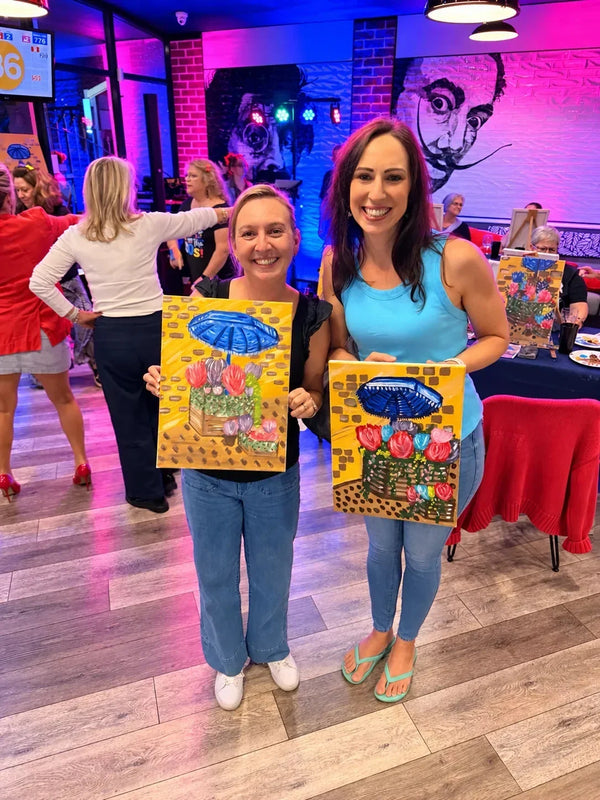
Lots of our guests are rebuilding their social calendar. Paint Juicy runs paint and sip nights of up to 3 hours with live hosts and a singalong, and the people booking are mostly women, from their thirties up into their nineties, who come with friends, sisters, workmates and mums. A mum and her grown-up daughter who used to share a house can now share a night out instead. When the theme lands, the room fills fast: our biggest nights run past 100 guests, and one ABBA Live night in Springfield had 151 booked.
For a brand, that's a room of people who have chosen something new and brought their friends along. With Paint Juicy CONNECT you can meet them on their terms. A take-home offer for your midweek lunch, styling night or taster session can go home through our product sampling and goodie bag options, ready to use once the week settles. If your customers are mostly women outside the capitals, pair this with our regional women over 40 guide.
The guests come first, always. If an idea would feel like an interruption to their night, it stays out.

Questions people ask about empty nester marketing
At what age do people usually become empty nesters?
There's no reliable typical age, and it's drifting later. Census data analysed by the Australian Institute of Family Studies shows young adults living at home for longer than in earlier decades, so a parent might find the house empty at 45 or not until well past 60. Use signals like household size and life events rather than age alone.
Are empty nesters a good audience for a small local business?
Often a very good one. They tend to know their town, have more say over their weeknights than a few years ago and are open to trying new places. A local business that becomes part of the new routine, the Wednesday lunch spot or the Friday walk-and-coffee café, can keep them for years.
How can I reach empty nesters if I can't target by life stage?
Go where the life stage shows up: midweek events, hobby groups, community noticeboards and local nights out. Then give existing customers who fit the description a simple offer to pass on to friends in the same boat.
What happens to my campaign if the adult children move back home?
Not much, if it's built on experiences rather than a sad empty house. Plenty of households empty and refill more than once. Offers built on friendship, discovery and time well spent still make sense with an extra pair of shoes by the door.
What tone works best for empty nester advertising?
Warm, specific and a little cheeky. Acknowledge the change without dwelling on loss, talk about what's now possible and show people enjoying it with their friends. Humour helps, especially about things everyone at this stage recognises, like still cooking for five out of habit.
Fill their new free nights
People with newly quiet houses are already booking seats with their friends at our nights across Queensland and New South Wales. Let us know what you'd love them to try and where you trade, and we'll map out the nights and formats that suit. Why Paint Juicy CONNECT? Because Paint Juicy connects!
Keen to see where the next nights land? Tap whichever state you trade in.
See what's on in each state
Keep reading
-
Marketing to baby boomers in Australia: how to earn the trust of a generation that's seen every trick
Marketing to baby boomers in Australia? Who they are, how they fill their week, how they use the internet and what earns their trust. Read the guide. -
Marketing to Gen X women: how to reach the generation raised on the 80s and 90s
Marketing to Gen X women? Learn who she is, what shaped her, how she uses media and the moves that earn her trust. Read the practical guide. -
Marketing ideas for tourism operators: win over the locals who host the visitors
Marketing ideas for tourism operators in regional QLD and NSW: turn locals into the ambassadors who bring visiting family to you. Read the playbook.